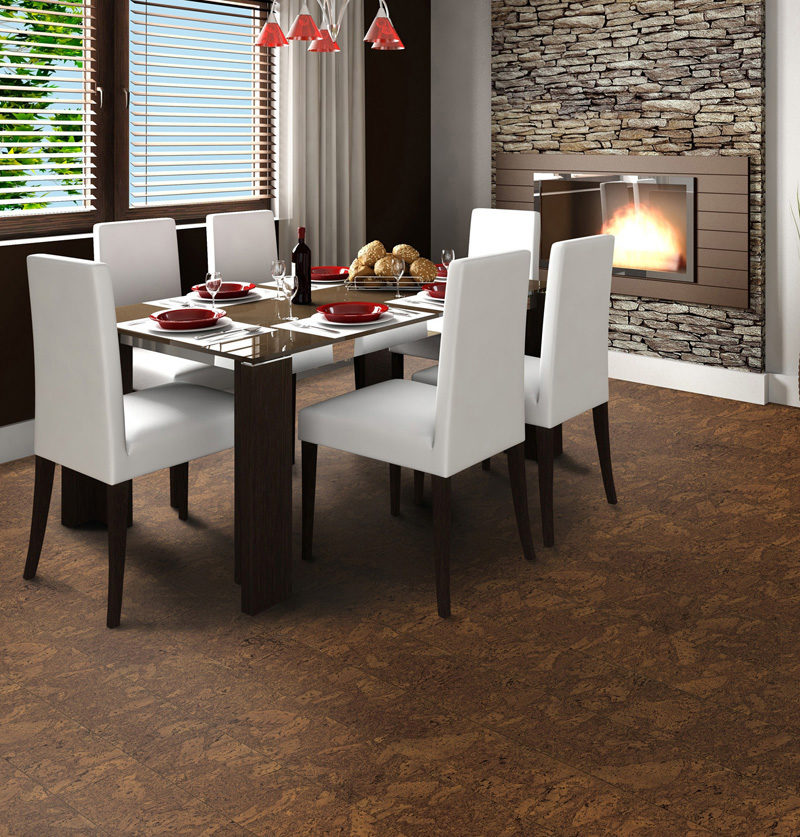
UNMATCHED ACOUSTIC COMFORT & THERMAL EFFICIENCY
The Smart, Sustainable, and Comfortable Choice
Cork flooring is the modern answer for homeowners seeking a truly unique blend of sustainability, resilience, and superior comfort. Cork’s natural cellular composition provides remarkable benefits, including significant noise reduction, a permanent thermal barrier against cold floors, and exceptional elasticity for comfort underfoot.
Decoding Cork’s Unique Benefits
Cork’s performance stems entirely from its unique cellular structure. To understand its value, focus on these technical pillars:
- Acoustic & Thermal Insulation: Cork’s material is composed of millions of tiny, air-filled, closed cells. This closed-cell structure makes it both an exceptional sound dampener (high NRC rating) and a natural insulator, providing a high R-value against cold subfloors.
- Indentation Resilience: Cork’s ‘memory’ or ability to recover from compression is determined by its density (measured in kg/m³). High-density cork (over 450 kg/m³) is used to ensure the floor bounces back from heavy furniture marks better than many softwoods.
Engineered Construction: Cork flooring is typically a multi-layer plank: a veneer surface, a central cork layer for comfort, an HDF core for stability, and often a bottom cork underlay for enhanced sound reduction.
Cork Flooring The Natural Thermal Barrier for London Winters
For London, Ontario homeowners, Cork is the only flooring that acts as a natural insulator, offering significant relief from cold subfloors common in basements and ground-level rooms. Cork’s unique cellular structure provides an R-value of approximately R-1.4 per 10mm of thickness, actively retaining heat and lowering energy costs during the cold season.
Furthermore, while wood expands only across the grain, cork disperses any expansion or shrinkage across its entire composition. This feature provides dimensional stability that is superior to solid hardwood, effectively managing the extreme relative humidity (RH) swings caused by cycling heating and cooling throughout the year.
For London, Ontario homeowners, Cork is the only flooring that acts as a natural insulator, offering significant relief from cold subfloors common in basements and ground-level rooms. Cork’s unique cellular structure provides an R-value of approximately R-1.4 per 10mm of thickness, actively retaining heat and lowering energy costs during the cold season.
Furthermore, while wood expands only across the grain, cork disperses any expansion or shrinkage across its entire composition. This feature provides dimensional stability that is superior to solid hardwood, effectively managing the extreme relative humidity (RH) swings caused by cycling heating and cooling throughout the year.
Compare Our Torlys Cork Solutions
We exclusively feature Torlys, which offers high-performance cork in various formats, each optimized for different installation needs:
|
Brand/Product Type |
Best For |
Key Feature/Technology |
Spec Data |
|
Torlys (Floating Planks) |
Comfort & DIY Installation |
TORLYS Maxx Commercial Finish for extreme wear/stain resistance. Bulldog™ Tool for easy plank replacement. |
CorkPlus™ Blue attached underlay with Microban® antimicrobial protection. HDF Core. |
|
Torlys (Glue-Down Tiles) |
High Moisture & High-Density Needs |
High-density solid cork construction (no HDF core) for superior stability when fully adhered/sealed. |
Highest density (>450 kg/m³) for dent recovery. Requires on-site urethane finish for impermeability. |
Frequently Asked Questions
1. What acoustic benefits does cork flooring provide?
Cork is an excellent acoustic insulator due to the air trapped in its closed-cell structure. It significantly reduces impact sound (footfalls) between floors (improving the IIC rating) and absorbs airborne sound within a room (high NRC rating of around 0.7).
2. How is cork’s indentation resistance measured?
Cork’s resistance is determined by its density (measured in kg/m³). High-density cork (over 450 kg/m³) provides superior ‘memory’ or recovery from compression, allowing it to bounce back from furniture indentations better than many softwoods.
3. Is cork flooring waterproof or just water-resistant?
Cork is naturally water-resistant due to the waxy substance suberin, but it is not inherently waterproof. Modern engineered cork with a rigid core and specific waterproof coatings is suitable for kitchens/bathrooms, but standing water must always be avoided.
4. What finish type is most durable for high-traffic cork floors?
A multi-layer, UV-cured polyurethane finish (often enhanced with ceramic or nano-beads) provides the highest resistance to scratches and wear. Hardwax oil offers a more natural, low-sheen look but requires more frequent maintenance.
5. Is cork suitable for installation over radiant heating systems?
Yes, cork is highly suitable. It provides a comfortable, warm surface and its dimensional stability handles heat fluctuations well. The temperature at the floor surface must not exceed 29°C (85°F), a limit common to most resilient floor coverings.
6. How does cork’s natural composition help with mold and pests?
Cork contains suberin, a natural waxy substance that acts as an insect repellent and is naturally antimicrobial. This makes cork an inhospitable environment for the growth of mold, mildew, and common pests.
7. Is cork flooring difficult to repair if a plank is damaged?
With most floating click-lock systems, replacing a damaged plank requires uninstalling back to the affected area. However, specialized systems (like Torlys Bulldog) allow a single plank to be removed and replaced mid-floor without disturbing the surrounding area.
8. Does cork flooring fade in direct sunlight (UV exposure)?
Yes, like all natural materials, cork is susceptible to UV fading and will naturally lighten or ‘mellow’ over time when exposed to direct sunlight. Using window treatments and rotating area rugs helps to ensure the fading is uniform.
9. What subfloor preparation is required for cork planks?
The subfloor must be clean, dry, and perfectly flat (within 3/16 inch over 10 feet). For installation over concrete, a 6-mil poly vapor barrier is mandatory, as moisture is the biggest threat to the HDF core found in floating cork planks.
10. Why is the harvesting process for cork considered eco-friendly?
Cork is harvested from the bark of the Cork Oak tree (Quercus Suber) without cutting down the tree. The bark regenerates every 9 to 12 years, making it a truly renewable and sustainable resource with a net carbon negative footprint.